
Rizo / First Political Campaign
sign up or sign in to add/edit transcript
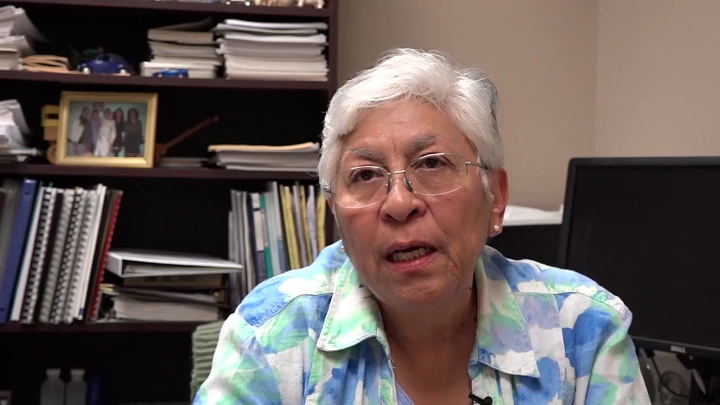
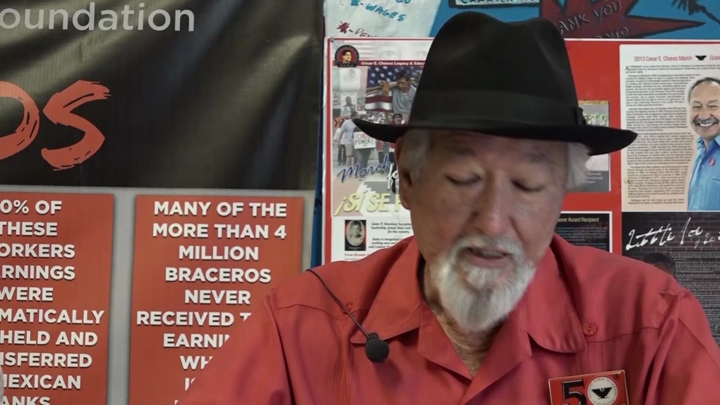
Interviewer-"So, after you dropped out of school when you got married and had four children, how did you start getting involved in PTA/community organization?" Ms. Rizo-Oh, , I wasn't involved. Interviewer-"You weren't?" Ms. Rizo-Yea. Interviewer-"How did you start getting involved in that?" Ms. Rizo-I got involved in the first political campaign at the age of 16 because my husband was on an organizing committee to bring in the union where he was working when we got married. And, as part of that committee, he would go and talk to some of the workers in their homes after work, but he couldn't talk to the female workers without having problems with the husband, so he would take me and I would talk to the wives. Interviewer-"And, where did he work?' Ms. Rizo-He worked at carpentry type business. Uh, I think it was called, they used to do it indoors as it was an overhead garage door company and so, it was a carpenter type work. So, it was a United Brotherhood of Carpenters and [?] of America Local Councel 272, lol! I can't believe I still remember that, anyway, um, because he was active in the union, he became the Stuart, which meant he had to keep communication with all the workers and I would help him with the female workers, so I helped him. So, I was learning organized labor kinds of things all along, then you became the business agent for the local union and he was a delegate to the FSA Council and he became the seageont at arms [?] he would take me with him to do whatever. So, I saw how they were working, so I got involved in the committee political education and so, I wound up in political campaigns. I had to wait until I was 21 to vote, but at the age of 16, I was already doing that. Interviewer-"So, when your husband took you over to female worker's houses, what would he have you do, is it [?]" Ms. Rizo-Just talk to them, meaning a lot of people from our neighborhood. I'm talking about the same neighborhood here in West Dallas, worked at that plant. So, most of the time we knew the woman cause I gone to school with them. Interviewer-"Mm, yea, ok." So, it wasn't a hard thing to do. And, the ones I didn't know, it was ok. I been raised to know how to talk with people, my grandmother [?] neither of them spoke English. So, they always told me that the purpose of my education was to help the community when I was meeting. And, then, whenever I was in public, if I saw a Mexicano, not being able to express himself or to be understood in English that I was to go and help. I wasn't supposed to go , I was supposed to go help, offer to help, not force it, to offer to help cause you don't ever tell people you just offer, like when you have someone in your home, your don't ask them if they want a glass of water or a cup of coffee, you serve it to them, and if they don't want to have it, you just let it go, but you don't ask, you just do.....
| Interview | Interview with Frances Rizo |
| Subjects | Oral Tradition |
| Family › Marriage | |
| Family › Extended Family Networks | |
| Work › Labor Unions | |
| Tags | American Federation of Labor and Congress of Industrial Organizations (AFL-CIO) |
| sign up or sign in to add/edit tags | |
| Interview date | 2015-06-10 |
| Interview source | CRBB Summer 2015 |
| Interviewees | Rizo, Frances |
| Interviewers | Acuña-Gurrola, Moisés |
| Bynum, Katherine | |
| Dulaney, W. Marvin | |
| Locations | Dallas, TX |
| Duration | 00:03:33 |
| Citation | "First Political Campaign," from Frances Rizo oral history interview with Moisés Acuña-Gurrola, Katherine Bynum, and W. Marvin Dulaney, June 10, 2015, Dallas, TX, Civil Rights in Black and Brown Interview Database, https://crbb.tcu.edu/clips/1025/first-political-campaign, accessed October 20, 2026 |