
Rizo / Discrimination in School
sign up or sign in to add/edit transcript
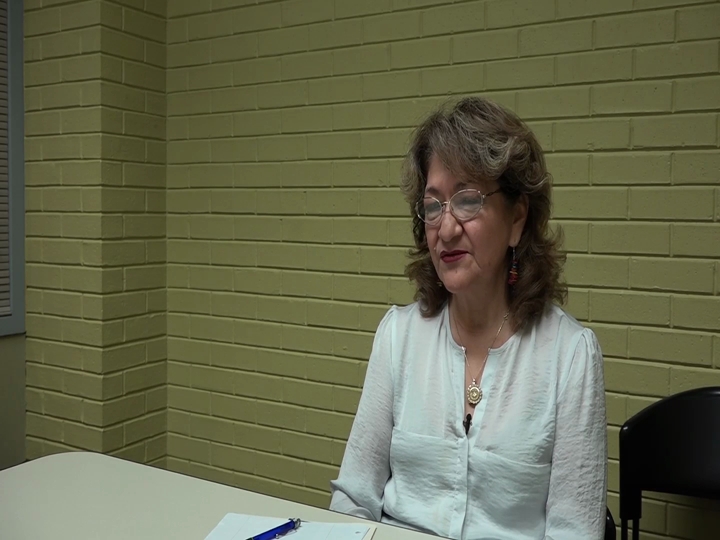
Interviewer-"Can you tell me about one of your first experiences with discrimination?" Ms. Rizo-Oh, Yea, first grade, Thomas Edison Elementary School, I have been privilaged, my mother couldn't afford to pay, I think it was five dollars a week to go to a kindergarten, she was working in a dress factory, that's why she could't afford to pay five dollars, it was prespatarian church in the neighborhood that had a kindergarten cause there was not public kindergarten back then and so, I got to go there, I did not speak English, but I memorized the alphabet, I could print, you know, my name, and I could say the days of the week, but I could not converse, I could not really understand in English, but its easier when your a teacher and back then, it was illegal for us to speak Spanish on the school grounds, we would get punished if we spoke Spanish. And, all of the teachers were white the majority of the kids were Mexican, but all the teachers were white. Um, I had a slight nose bleed and I couldn't figure out how to tell the teacher I had a nose bleed, so I raised my hand, I understood that I had to raise my hand, and so, because she couldn't , she called me up to the desk and I just pointed to my nose and cause I didn't, I had a tissue, but it was already wadded up and she didn't understand and she humiliated, I understand enough that she was humiliating me cause she was insisting that I tell her in English and I couldn't. So, she finally let me go to the restroom and clean my nose and by that time it stopped bleeding, but I still had to clean up, but I knew if I disrespected her, I remember putting my hands in a fist cause I knew I was being embarrassed and I knew I was being humiliated and if I didn't understand all the words and so, you can imagine how that affected me cause I'm telling you about it now at the age of 67 but, I got angry, I got angry because if I disrespected her and yet, she was disrespecting me and that would never happen in my home. So, I never told anybody about it, I think I told my mother about it after I was an adult or something. She wouldn't have known what to do about it, it would, you know, we just didn't have any rights, you know, it wouldn't have mattered to anybody, that a little kid had a nosebleed and couldn't say it, you know. But, um, I swore to myself at that time that I'm going to learn English and speak it better than the teacher and [?] by the fourth and fifth grade, I had the vocabulary of the teachers at [?] elementary school. I was a motivator for me. Interviewer-"Speaking English to prevent being embarrassed again like that?" Ms. Rizo-"No, to be superior. Interviewer-"OK" Ms. Rizo-It was anger, it wasn't the humiliation that motivated me, it was the anger that motivated me because I just didn't appreciate someone that knew, they knew I couldn't say it in English and they were demanding, I mean that's like saying, "Go cook me a steak dinner." When I don't even know how to turn on the stove because [?] is a wood burning. Interviewer-Right, Ok." Intervewer-"Um, do you remember the teacher's name?' Ms. Rizo-Oh no, no I was six years old, heaven only knows. God bless her wherever she is. Interviewers-"LOL!" Ms. Rizo-I'm sure nothing only when she did that to, and at [?] we had teachers like that too. There was one teacher, I'm not going to say her name cause I'm trying to remember what it is. I can still see her face in my mind right now. She was a retired Army sargeont and she would walk up to the boys, I'm talking Chicanos that are adolescents cause our elementaries schools went to the eighth grade, again because of segragation and we were not allowed to the one junior high school in Dallas cause it was for Blacks. Um, she would grab them by the shirt, by the back of the shirt and slam them up against the wall. She would humiliate them something awful, we were humiliated, but we were powerless, there was nothing we could do about it and the principal didn't do anything. I mean, it was common practice, they could do anything with us if they wanted, I'll never forget that. Interviewer-"I don't know how you could to see that." Ms. Rizo-Well, you know people integrate that to their systems in different ways. I like to think that I used that energy to become an activist. Interviewer-"Mmm"
| Interview | Interview with Frances Rizo |
| Subjects | Discrimination or Segregation › Discrimination or Segregation at School |
| Education › Speaking Spanish at School | |
| Education › Corporal Punishment in Education | |
| Tags | Thomas A. Edison Elementary School, Dallas, TX |
| Gabe P. Allen Elementary School, Dallas, TX | |
| sign up or sign in to add/edit tags | |
| Interview date | 2015-06-10 |
| Interview source | CRBB Summer 2015 |
| Interviewees | Rizo, Frances |
| Interviewers | Acuña-Gurrola, Moisés |
| Bynum, Katherine | |
| Dulaney, W. Marvin | |
| Duration | 00:05:03 |
| Citation | "Discrimination in School," from Frances Rizo oral history interview with Moisés Acuña-Gurrola, Katherine Bynum, and W. Marvin Dulaney, June 10, 2015, Dallas, TX, Civil Rights in Black and Brown Interview Database, https://crbb.tcu.edu/clips/1022/discrimination-in-school, accessed October 20, 2026 |